Showing posts with label Susan G. Komen Center for Public Policy. Show all posts

Tuesday, September 29, 2020

Patients' Access Webinar - Screening and Diagnostic Imaging

Patients' Access Webinar - Screening and Diagnostic Imaging


Join us on Thursday, October 8 at 12pm CDT/1pm EST for the next webinar in Komen's Patients' Access series, which will feature a panel discussion on breast screening and diagnostic imaging.


Millions of women across the country now have access to free screening mammography due to the inclusion of screening mammography as an essential health benefit under the Affordable Care Act (ACA). However, if diagnostic imaging is needed after an abnormality is found on a screening test, the patient may be faced with hundreds to thousands of dollars in costs — all before they  even know whether they have breast cancer. Although some insurers cover additional diagnostic imaging such as diagnostic mammography, ultrasound and breast magnetic resonance imaging (MRI), the costs vary greatly.


Come learn how state and federal policies impact access to these vital exams, the implications for providers and patients, and Komen's public policy efforts addressing these financial barriers. Register today!


Image


Wednesday, May 20, 2020

Advocacy Update for the Susan G. Komen Center for Public Policy

Image

Dear Cathy,

Too often, patients receive a surprise medical bill for treatment they expected to be covered by
 insurance. It’s a harmful practice that throws millions of Americans into financial crisis, and one that
consistently affects those impacted by breast cancer. This problem is even more widespread.
More than half of Americans have received a surprise medical bill, but you can help change that by contacting your members of Congress today! 

Now more than ever – amidst a global pandemic – patients could be forced to an out-of-network hospital if
 their in-network option is overcrowded or unavailable. As Congress works to pass multiple COVID-19

economic relief packages for hard-working Americans,
it is time to stop surprise medical billing once and for all to protect patients from financially crippling medical bills. 

If you have been faced with a surprise medical bill, we need to hear your story. Share it with us here.

Image

Susan G. Komen, 5005 LBJ Freeway, Suite 526, Dallas, Texas 75244
Don't like these emails? Unsubscribe 

Friday, March 27, 2020

Advocacy Action Update from the Susan G. Komen Center for Public Policy

iamsgk-auto_responder.png
Twitter komen.org
Action Update

We're All In This Together.pngThank you to our advocates who took action this week in support of Congress’ most recent coronavirus relief package! The legislation, which was just signed into law by President Trump, provides critical protections and funding not only to community-based charitable organization, like Susan G. Komen, but every person impacted by this crisis. A summary of the legislation is provided below.

As the impact of the Coronavirus 2019 (COVID-19) continues to expand, thank you for using your voice to demand action. We continue to hear from breast cancer patients who are losing their incomes, fearing the impact the virus will have on their health and experiencing issues that have limited their ability to access the care they require. We are closely monitoring new developments and the impact on the communities we serve.

If you have a story to share, we want to hear from you during this difficult time. Whether you’ve been unable to access the care and treatment you need, either in person or through telehealth, have experienced delays in your treatment, or are unable to pay for your care due to financial insecurity. Contact us at policy@komen.org and tell us what challenges you are now facing due to COVID-19.
Komen has recently established the Komen COVID-19 Action Fund to support urgent needs among our breast cancer community today. Learn more about the fund here.

If you need support during this difficult time, the Komen Breast Care Helpline, 1-877-GO-KOMEN (1-877-465-6636), provides information, psychosocial support and help with coping strategies related to anxiety or concerns during these uncertain times. The service is offered in English and Spanish from 9:00am-10:00pm ET. Email the helpline directly at helpline@komen.org.


Coronavirus Aid, Relief, and Economic Security (CARES) Act
The legislation takes a multipronged approach to confronting the mounting crisis. It contains several measures aimed directly at helping workers, including stimulus checks for millions of Americans, and others to shore up the government safety net, with provisions such as more food stamp spending and more robust unemployment insurance benefits. It also includes numerous provisions to help businesses, providing them with zero-interest loans, tax breaks and other subsidies. The bill also includes some measures aimed at addressing the public health crisis.

Charitable Giving Incentive: The CARES Act includes a new above-the-line universal deduction for charitable contributions of up to $300. The incentive applies to contributions made in 2020. The bill also lifts the existing cap on annual contributions for those who itemize, raising it from 60 percent of adjusted gross income to 100 percent. For corporations, the bill raises the annual limit from 10 percent to 25 percent.

Hospitals and health-care spending: The legislation includes hundreds of billions of dollars in funding to help prepare America’s healthcare infrastructure for responding to the coronavirus. A $100 billion fund was developed for hospitals and providers hit hardest by the outbreak, which can be used for protective gear for healthcare workers, testing supplies and emergency operation centers, among other necessities. The legislation also increases funding for community health centers; Medicare payments; telehealth and home service; and public health agencies such as the Center for Disease Control and Prevention.

$1,200 checks for millions of Americans: The package will send direct checks to tens of millions of families to stimulate the economy. The legislation would give taxpayers $1,200 per adult and $500 per child. The benefit would be smaller for individual taxpayers earning over $75,000 annually (or $150,000 for a couple filing jointly) and disappear altogether for individuals earning over $90,000 (or $180,000 for a couple). Eligibility for the benefit will be determined by a taxpayers’ 2019 or 2018 tax returns.
Increase in unemployment insurance benefits: The legislation will also dramatically beef up unemployment insurance benefits to protect workers from expected job losses in the coming weeks. It extends unemployment benefits to people who may not have been fired but are unable to work as a result of coronavirus — because they are sick, quarantined or need to take care of a child forced to stay home from school. The federal government will provide an additional $600 a week on top of existing unemployment benefits, which currently average about $300 a week, for four months.

Emergency aid for state and local governments: States are expected to be hammered by the economic crunch, both with rising costs as people seek additional public assistance and lower tax revenue because of falling business activity. The federal aid package provides $150 billion to state and local governments, including $8 billion for tribal governments.

Aid to large businesses and corporations: The legislative package includes a provision for hundreds of billions of dollars in loans for large businesses getting hit hard by the outbreak. It includes $25 billion in grants for the passenger airlines; $25 billion in loans for passenger airlines; $17 billion for companies deemed critical to national security; and $425 billion for other businesses, cities and states, allocated through funding mechanisms set up by the Federal Reserve.

Emergency aid for small businesses. The bill also aims to help small companies weather the economic storm. It does so through generous zero-interest loans for businesses, including charitable organizations, with fewer than 500 employees — loans that could be forgiven if the businesses follow certain conditions, such as not firing their workers. The loans convert to grants if used for covering employee salaries, rent, paid leave, utility payments, health insurance premiums or other necessities or worker protections.

Thank you for your support – together we can get through this critical time.
Komen Center for Public Policy
CPP AI Footer.png
komen.org | privacy policy | unsubscribe
For breast health or breast cancer information call:
1-877 GO KOMEN (1-877-465-6636)
© 2020 Susan G. Komen®

Sunday, March 22, 2020

Advocacy Request --Acton Alert

iamsgk-auto_responder.png
Twitter komen.org
AI Alert Header.png
Dear Cathy

We need your help. The damage from Coronavirus 2019 (COVID-19) extends to those battling breast cancer. We’ve already seen patients losing income, fearing for their health, and many unable to access the care they need. Our work has never been more important, but the impact of COVID-19 makes it more urgent. We are closely monitoring new developments and the impact on the communities we serve.
Come Together w. Voices.png
We continue to support life-saving research and serve your community through crucial patient assistance programs, and that can’t stop. However, the impact on Komen’s ability to raise the money needed to fulfill its mission helping breast cancer patients, survivors and caregivers is at risk.

As you read this, the U.S. Senate is crafting a coronavirus relief package. We need to make sure your senators know that community-based charitable organizations, like Susan G. Komen, should be part of that package. Please take action now!

Meanwhile, we will keep you informed as things progress. News stories are changing rapidly and social media can often be confusing, you can find the latest evidence-based information here. Komen statements and additional information is also available from our Newsroom.

And, if you need support, the Komen Breast Care Helpline, 1-877-GO-KOMEN (1-877-465-6636), provides information, psychosocial support and help with coping strategies related to anxiety or concerns during these uncertain times. The service is offered in English and Spanish from 9:00am-10:00pm ET. Email the helpline directly at helpline@komen.org.
Thank you for your support – together we can get through this critical time. 

Sincerely,
Susan G. Komen Public Policy & Advocacy Team
CPP AI Footer.png

komen.org | privacy policy | unsubscribe
For breast health or breast cancer information call:
1-877 GO KOMEN (1-877-465-6636)
© 2020 Susan G. Komen®

Thursday, March 19, 2020

Patients' Access Webinar Series - Metastatic Breast Cancer Step Therapy

iamsgk-auto_responder.png
Twitter komen.org
PAT Updated Banner MBC Step Therapy.png

It’s not too late to join us this coming Tuesday, March 24th at 12pm CDT/1pm EDT for our next webinar in Susan G. Komen's Patients' Access webinar series, which will focus on the use of step therapy protocols for metastatic breast cancer (MBC) patients.
Step therapy, also referred to as “fail first”, requires a patient to use a health plan preferred drug first and have that therapy fail before they can receive coverage for the originally prescribed drug. Step therapy is especially harmful to MBC patients, who have often already been through multiple treatments and whose disease will likely progress while on the health plan-preferred drug. Ensuring MBC patients have the treatment originally prescribed for them can be a matter of life or death.
This webinar will provide an overview of step therapy, how providers can play a role in fighting these protocols and what Komen is doing to advocate for public policies to limit the use of step therapy for metastatic cancer patients.
Register today!
CPP AI Footer.png
komen.org | privacy policy | unsubscribe
For breast health or breast cancer information call:
1-877 GO KOMEN (1-877-465-6636)
© 2020 Susan G. Komen®

Thursday, March 5, 2020

March 2020 Advocacy Update- Komen Center for Public Policy

iamsgk-auto_responder.png
Twitter komen.org
AI Header.png
March 2020 Updates 

Support the Protecting Access to Lifesaving Screenings Act
PALS_AI_Cropped.pngThe most recent recommendations from the United States Preventive Services Task Force (USPSTF), an independent panel of experts that makes recommendations for clinical preventive services, posted in 2016, stated that the decision to start screening mammography before the age of 50 should be an individual one and take patient context into account, while women ages 50-74 should only have screening mammograms every other year.
Because many insurance companies use USPSTF guidelines as the basis for coverage, 22 million women between the ages of 40 and 49 could be at risk for losing coverage for screening mammograms and those over 50 would only have coverage every two years. While rates of breast cancer are low in women under 50, the risk for breast cancer increases starting at age 40. Additionally, breast cancer is the leading cause of cancer death among women ages 40-49 in the United States.
We must ensure affordable access to life-saving screening needed to find breast cancer as early as possible. Take action now and ask your lawmakers to support the Protecting Access to Lifesaving Screenings (PALS) Act!

Patients’ Access Webinar – Metastatic Breast Cancer Step Therapy
MBC PA_AI.pngPlease join us on Tuesday, March 24th at 12pm CDT/1pm EDT for our next webinar in Susan G. Komen's Patients' Access webinar series, which will focus on the use of step therapy protocols for metastatic breast cancer (MBC) patients.
Step therapy, also referred to as “fail first”, requires a patient to use a health plan preferred drug first and have that therapy fail before they can receive coverage for the originally prescribed drug. Step therapy is especially harmful to MBC patients, who have often already been through multiple treatments and whose disease will likely progress while on the health plan-preferred drug. Ensuring MBC patients have the treatment originally prescribed for them can be a matter of life or death.
This webinar will provide an overview of step therapy, how providers can play a role in fighting these protocols and what Komen is doing to advocate for public policies to limit the use of step therapy for metastatic cancer patients.
Register today!

Call for Stories
Story Banking AI.pngOur lawmakers are overwhelmed with numbers and studies. What they need most are stories about people - real people. Like you.
Lawmakers and regulators must see the impact policies can have on breast cancer patients. Help us shape policy that makes sense for those impacted by breast cancer.
With your help, we can influence them to take action to expand access to high-quality, affordable health care for all patient populations. You have a story to tell – share it with us. 

Federal Policy & Advocacy Updates

Appropriations
Approps_AI.pngThe White House released their proposed fiscal year 2021 (FY 2021) budget in early February that proposed a massive cut to the Department of Health and Human Services (HHS), which would result in significant reductions to medical research, screening and prevention programs, as well as workforce training and other health programs.
While many lawmakers on the Senate Labor – Health and Human Services Committee have said the proposed HHS budget cuts would be rejected, it is too early to determine what changes could be seen in negotiations.
Komen will continue to advocate for increased funding for critical, life-saving cancer research, prevention, screening and treatment programs.
Learn more about Komen’s appropriations requests and join us in taking action.

Affordable Care Act Update
The U.S. Supreme Court announced this week that it will hear challenges on the Affordable Care Act (ACA), Texas v. U.S. and California v. Texas. It is likely oral arguments will not be heard until the fall, with a decision coming as late as June 2021. Until a decision is made, the majority of the law remains intact.
You can learn more about the status of the Affordable Care Act in one of our Patients’ Access webinars  held in December 2019.
Until a decision is made, it is imperative that we continue to advocate for the patient protections included in the ACA and additional protections that are still needed. Add your name to our petition for the Breast Cancer Bill of Rights to sign up for action alerts and take a stand.

State Policy & Advocacy Updates

2020 State Legislative Update
We Will Never Stop_AI.pngBuilding off the tremendous successes Komen had in 2019, the Public Policy & Advocacy Team has been hard at work to ensure 2020 is even more successful!  With most state legislative sessions under way, the team has been working with advocates across the country to engage and educate legislators on Komen’s Advocacy Priorities. We are so pleased to announce that Komen has led the introduction of state legislation to eliminate out-of-pocket costs for diagnostic imaging, as well as legislation prohibiting insurers from requiring step therapy protocols for metastatic cancer in several key states. Please stay tuned for details on these efforts and our advocacy work across the country. 

Susan G. Komen Puget Sound Highlighted Nationally
Every year, the Centers for Disease Control and Prevention (CDC) provides a justification document to Congress during the budget process. This document serves as the CDC’s budget request and provides details on specific programs.
In the FY2021 justification, Komen’s Puget Sound Affiliate was mentioned in the National Program of Cancer Registries section. The highlight details how the Affiliate used the Washington State Cancer Registry data in their Community Profile, and how the information impacted programming and granting for the Affiliate. Please join us in congratulating Puget Sound on this exciting effort!

General Policy & Advocacy Updates

STTP 2020 Promotion (2).png2020 Speak Truth to Power Conference – Advocating to Achieve Health Equity
Komen will not achieve its Bold Goal without engaging the African-American community, where the impact of breast cancer is the most devastating. African-American women are 40 percent more likely to die from breast cancer than their white counterparts. Through the Speak Truth to Power: Advocating to Achieve Health Equity Conference, Komen will convene community health leaders and advocates to learn about the role public policy and advocacy plays in reducing breast cancer disparities and the importance of engaging in these efforts.
The 2020 Komen Speak Truth to Power Conference and Advocacy Summit will be held at the Crystal Gateway Marriott (1700 Richmond Highway, Arlington, VA 22202) beginning the evening of June 7, 2020. Following the conference, attendees will participate in the Komen Advocacy Summit.
Application are due TODAY, March 5! Click here to learn more and apply.

We're Hiring!
We are searching for a Regional Manager, State Policy and Advocacy (Northeast Region). This position will serve as a subject matter expert, supporting and promoting Susan G. Komen’s public policy and advocacy initiatives related to breast cancer and public health policy in the Northeast Region. The Northeast Region includes Connecticut, Maine, Maryland, Massachusetts, New Hampshire, New Jersey, New York, Pennsylvania, Rhode Island, Vermont, Virginia and West Virginia.
Please feel free to share with others that might be interested in applying.
CPP AI Footer.png
komen.org | privacy policy | unsubscribe
For breast health or breast cancer information call:
1-877 GO KOMEN (1-877-465-6636)
© 2020 Susan G. Komen®

Thursday, February 27, 2020

Advocacy Insider -ACTION ALERT !

iamsgk-auto_responder.png
Twitter komen.org
Advocacy Action Alert Header.png
Support the Protecting Access to Lifesaving Screenings Act
While rates of breast cancer are low in women under 50, the risk for breast cancer increases starting at 40. Additionally, breast cancer is the leading cause of cancer death among women ages 40-49 in the United States.
 
PALS Action Alert.pngThe most recent recommendations from the United States Preventive Services Task Force (USPSTF), an independent panel of experts that makes recommendations for clinical preventive services, stated that screening for women ages 40-49 should only be performed selectively, while women ages 50-74 should only have screening mammograms every other year.
 
Because many insurance companies use USPSTF guidelines as the basis for coverage, 22 million women between 40 and 49 could be at risk for losing coverage screening mammograms and those 50 and older would only have coverage every two years. We have to protect these women and ensure that everyone has access to life-saving screening needed to diagnose breast cancer.
 
CPP AI Footer.png
komen.org | privacy policy | unsubscribe
For breast health or breast cancer information call:
1-877 GO KOMEN (1-877-465-6636)
© 2020 Susan G. Komen®

Wednesday, February 5, 2020

Advocacy Insider from Susan G. Komen Center for Public Policy

Advocacy Insider Headers.png

February 2020 Updates

2020 Speak Truth to Power Conference – Advocating to Achieve Health Equity
STTP Insider.pngKomen will not achieve its Bold Goal without engaging the African-American community where the impact of breast cancer is the most devastating. African-American women are 40 percent more likely to die from breast cancer than their white counterparts. Through the Speak Truth to Power: Advocating to Achieve Health Equity Conference, Komen will convene community health leaders and advocates to learn about the role public policy and advocacy plays in reducing breast cancer disparities and the importance of engaging in these efforts.
The 2020 Komen Speak Truth to Power Conference and Advocacy Summit will be held at the Crystal Gateway Marriott (1700 Richmond Highway, Arlington, VA 22202) beginning the evening of June 7, 2020. Following the Conference, attendees will participate in the Komen Advocacy Summit.


Federal Policy & Advocacy Updates
Appropriations
Approps Insider.pngJust before adjourning for the holidays in December, Congress approved the fiscal year (FY) 2020 spending package and it was signed by President Trump. The budget included an increase of $2.6 billion for the National Institutes of Health (NIH), bringing its total budget to $41.7 billion. The NIH budget included $296 million increase for the National Cancer Institute (NCI) for a total budget of $6.44 billion. The funding specifically included money for NCI to increase the number of research grants it funds in a year.
Within the Centers for Disease Control and Prevention (CDC) budget, the National Breast and Cervical Cancer Early Detection Program (NBCCEDP) received level funding of $197 million. The bill also includes a new $50 million initiative to support a data modernization effort at the CDC and directs CDC to prioritize advancements in cancer registries, a priority of our coalition efforts as well.
Finally, the Breast Cancer Research Program (BCRP) at the Department of Defense (DOD) saw an increase of $20 million in the spending agreement.
We applaud Congress and thank members for the increase in funding dedicated to breast cancer research and expanding access to breast care!
It is now time to turn our attention to the next budget cycle (FY2021). With more than 270,000 new cases of invasive breast cancer estimated to be diagnosed in 2020, we don’t have time to lose. We are calling on our lawmakers to increase funding for life-saving programs through the NIH, CDC, and DOD.

Access to Breast Cancer Diagnosis (ABCD) Act Introduced in Senate
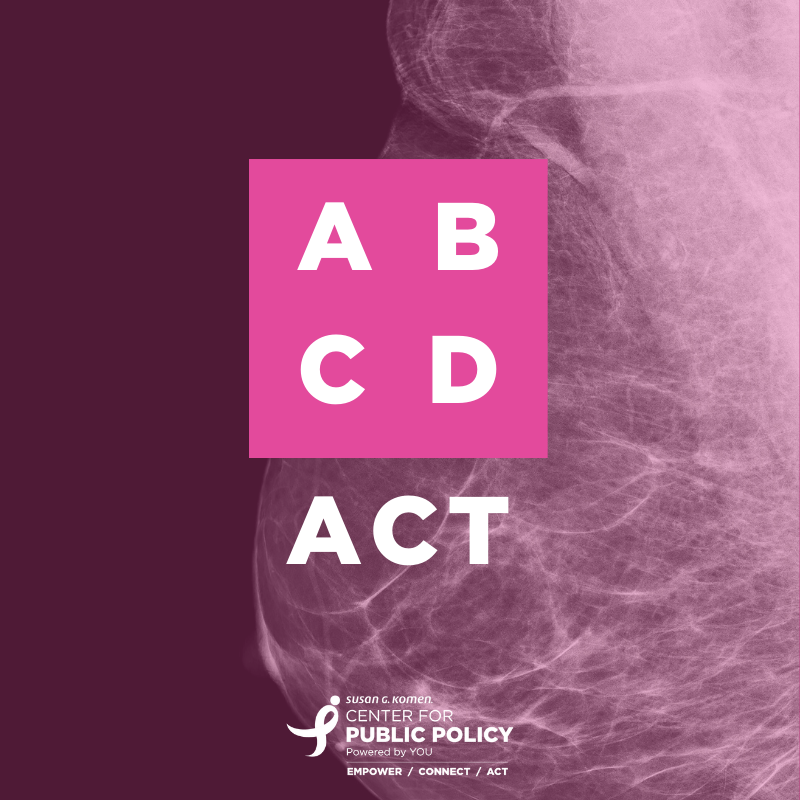
ABCD Act_Insider.pngIn 2019, we worked in partnership with Congresswoman Debbie Dingell (D-MI) to introduce federal legislation in the U.S. House of Representatives, H.R.2428, to increase women’s access to diagnostic imaging by eliminating cost-sharing for medically-necessary diagnostic breast imaging (diagnostic mammography, breast ultrasound, breast MRI). After a year of advocating for this critical legislation, we are excited to announce that Senators Roy Blunt (R-MO) and Jeanne Shaheen (D-NH) have introduced a companion bill for the Access to Breast Cancer Diagnosis (ABCD) Act in the U.S. Senate, S.3216.
“Early breast cancer detection saves lives,” said Blunt. “Screening is vital, but getting the diagnosis confirmed so patients can start treatment as soon as possible is just as important. By ensuring full coverage of cancer diagnostic tests, this bill eliminates a major hurdle to care, leading to lower treatment costs and better outcomes.”


State Policy & Advocacy Updates
New Jersey
Thank You NJ_Insider.pngGovernor Murphy signed critical legislation into law on January 21st that will help breast cancer patients and survivors in New Jersey afford their medications. A2431 requires insurance providers in the state to offer plans with lower cost-sharing for prescription drugs, providing patients with more affordable treatment options so they can focus on getting well instead of on out-of-pocket costs.
Thank you to our advocates that took action! Thanks to you, New Jersey women won’t have to make the choice between paying for their medications or paying for food.


General Public Policy & Advocacy Updates
We're Hiring!
We are searching for a Regional Manager, State Policy and Advocacy (Northeast Region). This position will serve as a subject matter expert, supporting and promoting Susan G. Komen’s public policy and advocacy initiatives related to breast cancer and public health policy in the Northeast Region. The Northeast Region includes Connecticut, Maine, Maryland, Massachusetts, New Hampshire, New Jersey, New York, Pennsylvania, Rhode Island, Vermont, Virginia and West Virginia.